
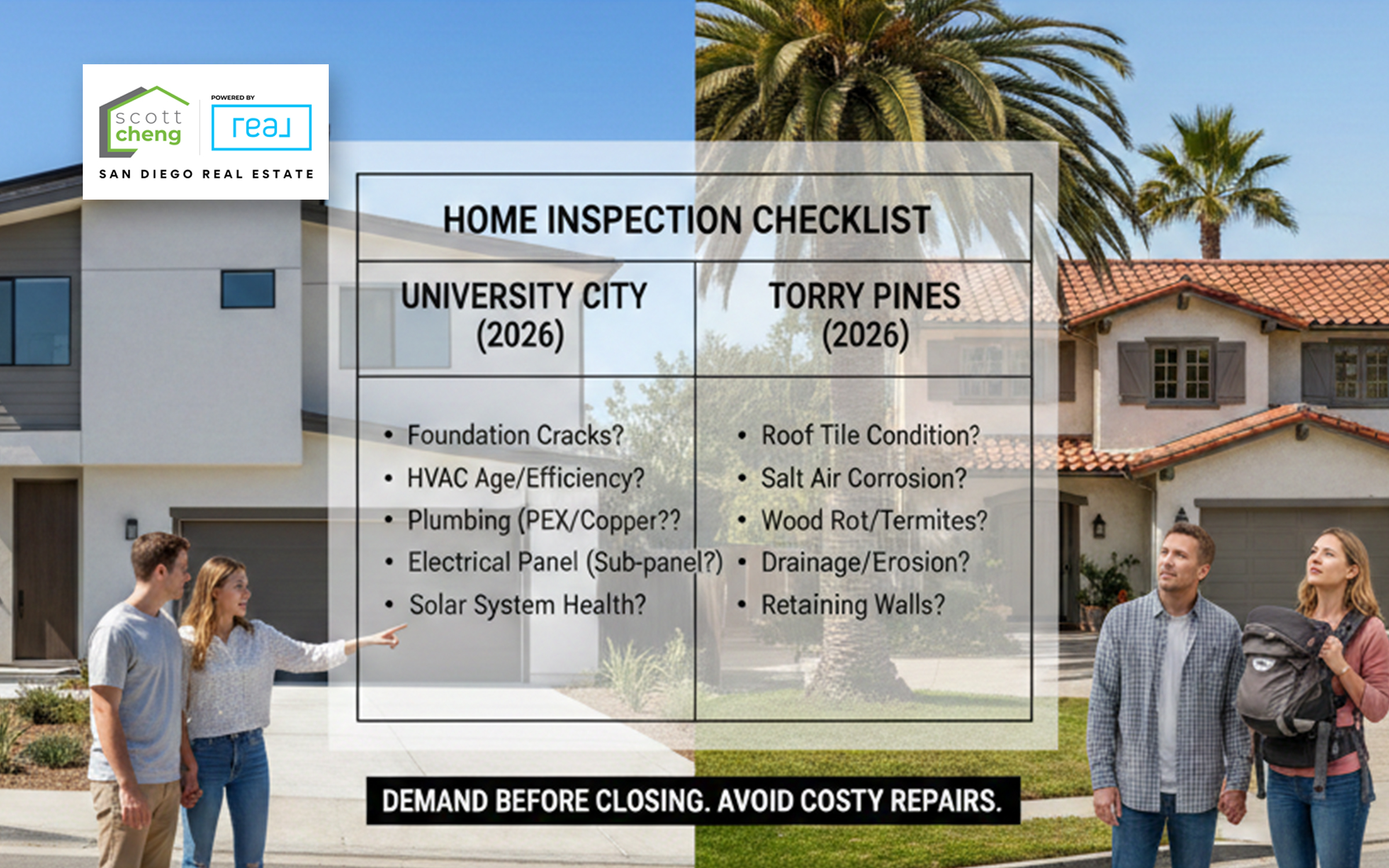
# San Diego Home Inspection Checklist for First-Time Buyers 2026: What to Demand Before Closing in University City vs Torrey Pines to Avoid Costly Repairs
San Diego Home Inspection Checklist for First-Time Buyers 2026: What should you demand before closing in University City vs Torrey Pines to avoid costly repairs?
[SNIPPET ANSWER: Demand a full home, roof, sewer, and termite inspection, salt-air corrosion check, permit history, HOA reserve and SB 326 report (for condos), seller Section 1 termite clearance, and a 1-year home warranty before removing contingencies.]
You are buying into one of the most competitive markets in California, where limited inventory and high prices make mistakes expensive. San Diego’s median was about $900,000 in May 2025, with detached homes near $1,100,000 and attached around $690,000, per local Realtor data. That means a missed roof leak or failing sewer lateral can cost five figures fast. With roughly two months of inventory keeping leverage tight, you often have just days to inspect and decide. Your timing could also coincide with rate swings, so your buffer for unexpected repairs matters while you protect your loan approval and rate lock. Whether you are focused on University City or Torrey Pines, or also considering nearby La Jolla and Clairemont, your inspection strategy is your safeguard against costly surprises and your strongest negotiating tool before closing.
You should use an inspection package that reflects coastal and canyon risks common in University City and Torrey Pines. Your goal is to convert unknowns into documented issues you can price, repair, or negotiate.
Key takeaways:
You will evaluate two excellent but different micro-markets. University City mixes 1960s–1980s single-family homes east of I-5 with newer condos near UTC. Torrey Pines leans coastal and premium, adjacent to Del Mar and the Torrey Pines State Reserve. Your inspection priorities shift with age, exposure, and construction type.
Negotiation strategy:
Key factors to evaluate:
1. Pre-offer reconnaissance. Walk the exterior, note roof type and age cues, look for cracking stucco, sloping floors, and moisture stains. Ask your agent to pull permit history before you write. 2. Offer with targeted contingencies. Include general, roof, termite, and sewer scope in writing. In a competitive situation, shorten your contingency period to 7–10 days only if your inspector and specialists can meet that timeline. 3. Schedule specialists up front. Book the home inspector, roofer, plumber for sewer scope, and pest inspector for the first 3–4 days. Backfill with HVAC and electrician as needed. 4. Get photographs and estimates. Insist on photos and line-item estimates for every material defect. This documentation strengthens your negotiation with the seller and your lender’s appraisal rebuttal if needed. 5. Review HOA documents in parallel. For condos and townhomes, evaluate reserve study, current budget, insurance coverage, pending litigation, SB 326 balcony reports, and any planned special assessments. 6. Risk-prioritized negotiation. Focus on health, safety, water intrusion, and structural items first. Decide whether you want repairs completed pre-close, seller credits, or a price reduction. Credits are often the cleanest in tight timelines. 7. Re-inspection and final walk-through. If repairs are completed, schedule re-inspection or documentation review by licensed contractors. Confirm receipts and permits where applicable. 8. Final protection. Request a 1-year home warranty that covers systems and appliances. Ensure termite Section 1 items are completed and cleared in writing. 9. Post-close maintenance plan. Calendar roof service, gutter cleaning, HVAC servicing, and exterior sealing in coastal zones. Set aside an annual reserve equal to 1% of price for preventive work.
Your inspection plan should reflect how San Diego’s pricing and inventory impact negotiation leverage. With median prices near $900,000 and only about two months of supply, you rarely get unlimited time for discovery. That is why a front-loaded, specialist-first approach works best. Local Realtor reports show detached homes around $1,100,000 and attached near $690,000, reminding you that roof and sewer issues can materially change your budget. In coastal pockets, salt-air maintenance is part of ownership, so factor ongoing costs into your payment comfort.
Your choice of a best San Diego realtor or top real estate teams in San Diego matters when you weigh credits versus repairs, especially if an appraisal is tight. A top realtor in San Diego or a seasoned real estate broker San Diego buyers trust will line up vetted inspectors quickly and structure clean credits that keep your financing intact.
Neighborhoods to consider in San Diego:
You might think a clean general inspection is enough. It is not. Coastal and canyon microclimates create issues generalists may not fully scope. Sewer laterals can look fine from fixtures but fail under camera. Tile roofs can look pristine, while underlayment is at the end of its life. Decks and balconies can seem solid, but waterproofing can fail invisibly. For condos, buyers often skip deep HOA diligence. Yet reserve shortfalls and deferred maintenance can lead to special assessments that add hundreds per month. Another misconception is that termite work is minor. In coastal pockets, termite and dry rot repairs can be extensive. Finally, many buyers try to negotiate a price drop instead of credits. In a tight market, credits often preserve your loan terms better and close faster. Your best strategy is to pair a thorough inspection stack with smart, finance-friendly negotiation guided by top San Diego real estate agents.
You should always order a general home inspection, roof inspection, termite inspection with seller-paid Section 1 clearance request, and a sewer scope. In coastal areas, add a salt-air corrosion review of windows, railings, and exterior metals to avoid hidden costs.
Aim for 7–10 days only if your inspector and specialists can meet that schedule. Pre-book vendors before your offer is accepted when possible. Coordinate with your lender so inspection timing does not jeopardize your appraisal or rate lock.
Yes. La Jolla shares Torrey Pines’ salt-air corrosion, termite, and deck waterproofing risks. Carmel Valley has newer stock, so emphasize roof underlayment life, builder quality, and HOA compliance. In both, demand permits, HOA reserve strength, and major system lifespans.
Request seller credits at closing tied to written estimates, or pre-close repairs by licensed contractors with receipts and permits. Credits often preserve your appraisal and loan-to-value. Insist on a clear termite Section 1 completion statement in writing.
Pull permit history and final inspections through the City of San Diego Development Services. Compare dates and contractor names to seller disclosures. If records are missing, price in risk or require retroactive permits where feasible.
You can avoid expensive surprises in University City and Torrey Pines by stacking a coastal-ready inspection plan: general, roof, termite with Section 1 clearance, and sewer scope, plus salt-air and canyon-focused checks. Verify permits, study HOA reserves and SB 326 reports for condos, and use written estimates to negotiate seller credits or repairs before removing contingencies. Whether you are zeroing in on UC and Torrey Pines or also weighing La Jolla and Clairemont, the same disciplined process gives you leverage in a low-inventory market and protects your budget long after closing.
If you're ready to explore your options for inspections and negotiations in San Diego or nearby communities, Scott Cheng at Scott Cheng San Diego Realtor can walk you through the specifics for your situation.
858-405-0002
https://www.findyourhomesandiego.com DRE# 01509668

